Hour boosting
Creating a plan
The plan wizard: basics, accounts, games, targets, schedule and limits.
Plans → New plan opens a wizard. Only the games step has a required choice, so you can accept the defaults for the rest and tune them later.
Basics
Just a name, and only you see it. Name it after what it is for ("Weekend hours", "CS2 grind") since this is what you will be reading on the plans list.
Accounts
Account groups is optional. Pick one or more of your groups and the plan boosts whoever is in them.
Accounts that join a linked group are added on the next boost cycle. Accounts that leave are taken off, unless you also added them by hand. You can still use Add accounts on the plan for a fixed list. Those stay until you remove them.
Leave the groups empty if you only want a hand-picked list.
Games
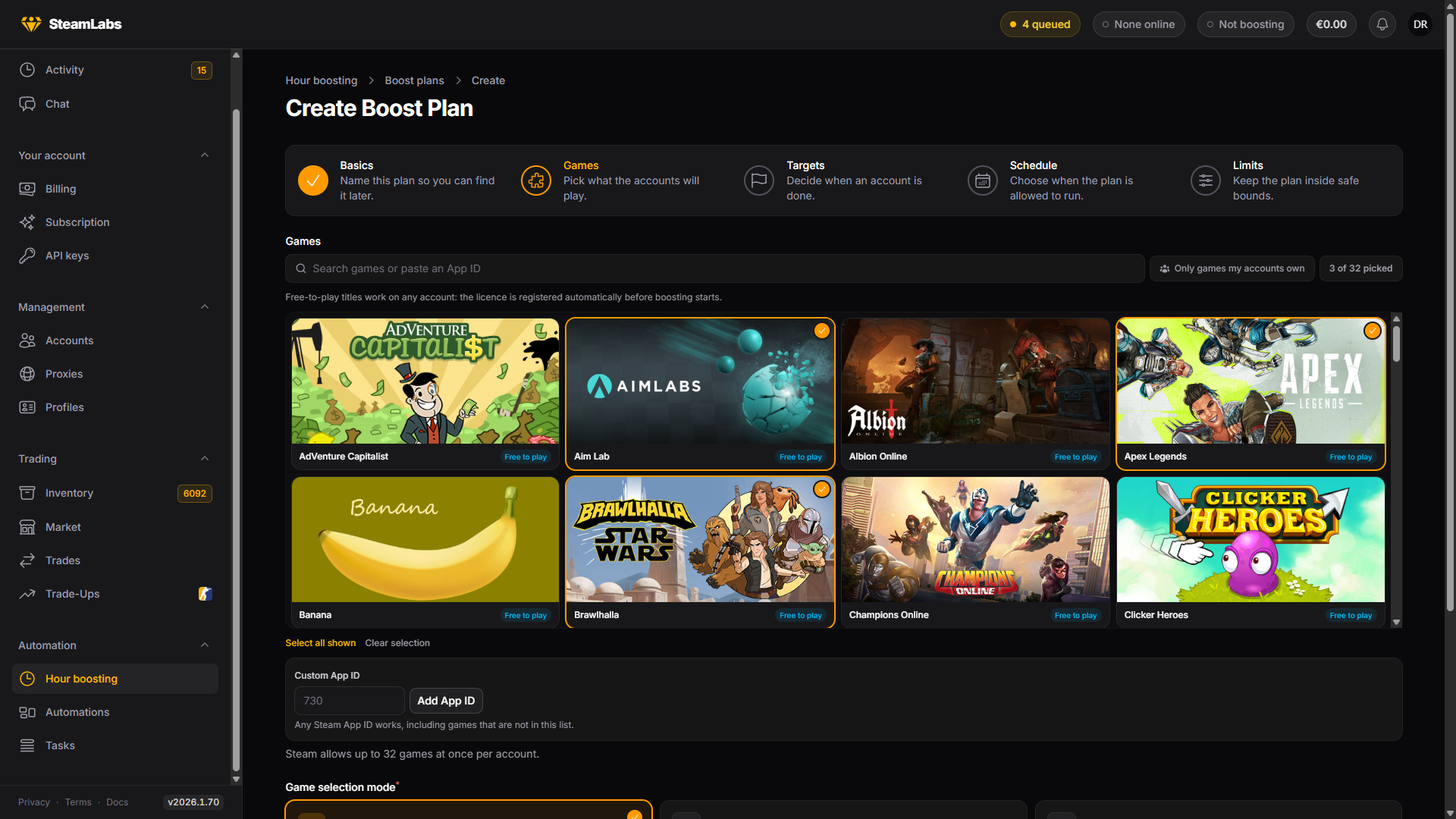
Pick what the accounts play. Search by name or paste an App ID, and use Only games my accounts own to narrow the list.
Two badges matter here:
- Free to play: works on any account. The licence is registered automatically before boosting starts
- Needs a licence: Steam does not hand this one out, so an account only counts hours for it if it already owns it
Custom App ID takes any Steam App ID, including titles not in the list. Custom game name is free text shown on the profile as a non-Steam game.
Game selection mode decides how your pool is split:
| Mode | What each account plays |
|---|---|
| Same games for everyone | All of the games you picked |
| Random pick per account | A random handful, chosen once when it starts |
| Rotating pick per account | Like random, but swapped for a fresh selection on a timer |
Random and rotating both take a Games per account count, and rotating additionally takes a swap interval, minimum 5 minutes. Use these when you want a fleet's playtime spread across a catalogue rather than every account showing the same title.
Show accounts as sets the persona state while boosting: online, away, snooze, invisible or offline. Hours count the same either way.
Targets
Target decides when an account is done:
| Target | Behaviour |
|---|---|
| No target | Runs until you stop it |
| Fixed target | Every account stops after the same number of hours |
| Random target | Each account draws its own target inside a range you set |
A random target is the useful one for a fleet. With a fixed target every account finishes at roughly the same moment, which is both a large simultaneous sign-out and a very uniform-looking set of profiles.
Targets are entered in hours here. Progress against them is tracked per account.
Schedule
Only run at set times turns on the weekly grid. Click and drag across it to select whole hours, and drag over selected hours to clear them. Presets cover always, nights, weekends and office hours.
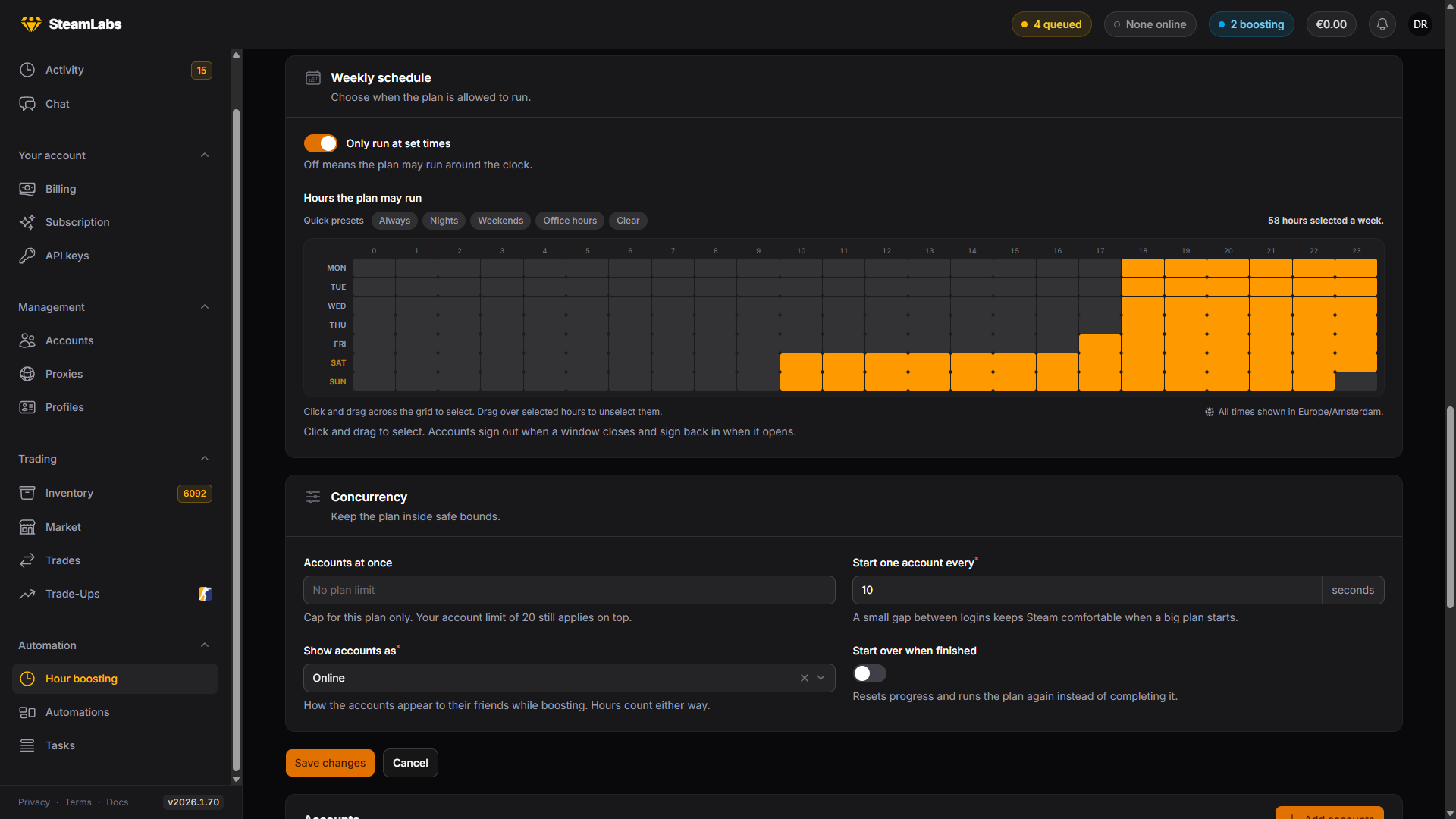
The grid is in your timezone, shown above it. When a window closes, accounts sign out and keep their progress. When the next window opens, they sign back in on their own.
Leaving the schedule off means the plan may run around the clock.
Weekly random sessions
The grid says when the plan may run. Weekly random sessions decides how each account actually spends that time, so a fleet does not all sign in at the same moment every evening.
Turn it on and set three ranges:
| Range | What it means |
|---|---|
| Hours per week | How much each account plays in a week, for example 10 to 20 hours |
| Days a week | How many different days those hours land on, for example 2 to 5 |
| Session length | How long one sitting lasts, for example 1 to 3 hours |
Every Monday (in your timezone) each account draws its own week: a total inside the hours range, a number of days inside the days range, and sessions of random length at random times on those days. No two accounts share a week, and a fresh one is drawn every week. One account might play 18 hours over four days this week and 12 hours over two days the next.
An account only boosts inside its own sessions. Between them it shows as Paused, and the run history records those ends as session ended. Games follow the plan's game settings as usual.
- With the grid on, sessions only land inside the hours you selected. "Never between 02:00 and 08:00" keeps meaning exactly that.
- A session an account could not play (it was busy with a task, offline, over your concurrency limit, or the plan was paused) is made up later in the same week when there is room. If the week runs out of room, the rest is lost and the next week starts clean.
- A plan started mid-week draws a smaller first week in proportion to the days left.
- A Fixed or Random target still ends an account when it reaches it, mid-week if that is when it lands. No target plus weekly random runs week after week until you stop it.
The Accounts tab on the plan shows each account's current week: hours played against this week's target, a seven-day strip with a block per session (green played, amber partly played, red missed, blue playing now), and what comes next. Hover the strip for every session with its times.
Limits
Accounts at once caps this plan alone. It never raises your account-wide ceiling, it only makes one plan gentler than it is allowed to be. Leave it empty for no per-plan cap.
Start one account every puts a gap between logins, five seconds by default. A big plan starting all at once is a burst of Steam logins from your proxies, and the stagger is what keeps that comfortable.
Start over when finished resets every account's progress on completion and runs the plan again, instead of parking it as completed.
Attaching accounts and starting
A new plan is a draft. If you linked account groups, those members are attached as soon as you save. You can also open the plan and use Add accounts for a fixed list, then press Start.
Accounts already on another plan are skipped rather than refused, and the notification tells you how many. A plan with no games or no accounts cannot start, and says which is missing. A linked group that still has members counts as having accounts.