Inventory
Overview
Every item across every account on one page, and the five things you can do with a selection.
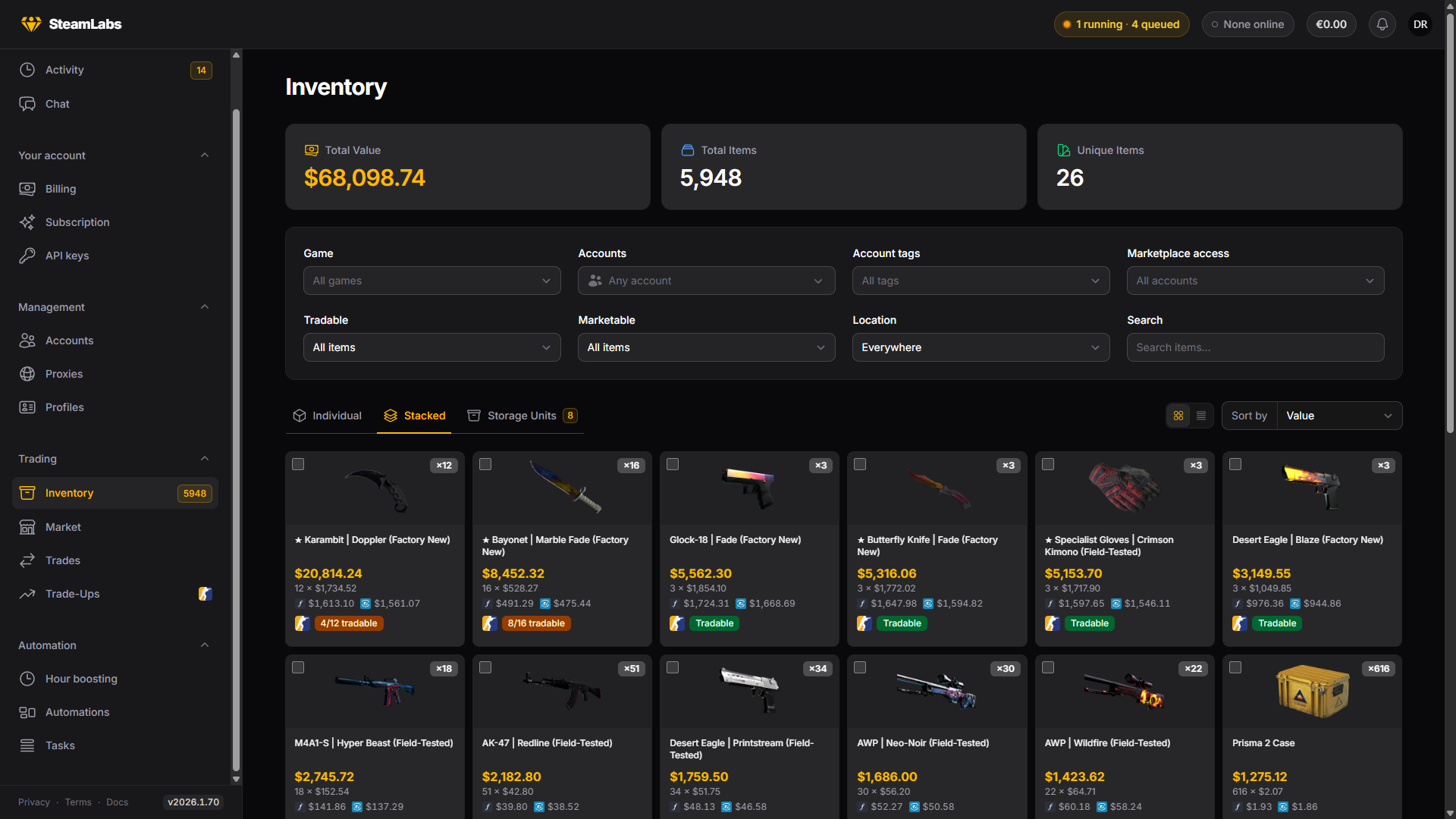
Inventory sits in the Trading group and holds every item on every account you own. It is also the place most item work starts: selling, sending, storing, using and trading up all begin with a selection here.

How items get here
Items are not read live. They land after an account completes an inventory sync, which is part of the Refresh Details task. Until an account has run one, it shows nothing.
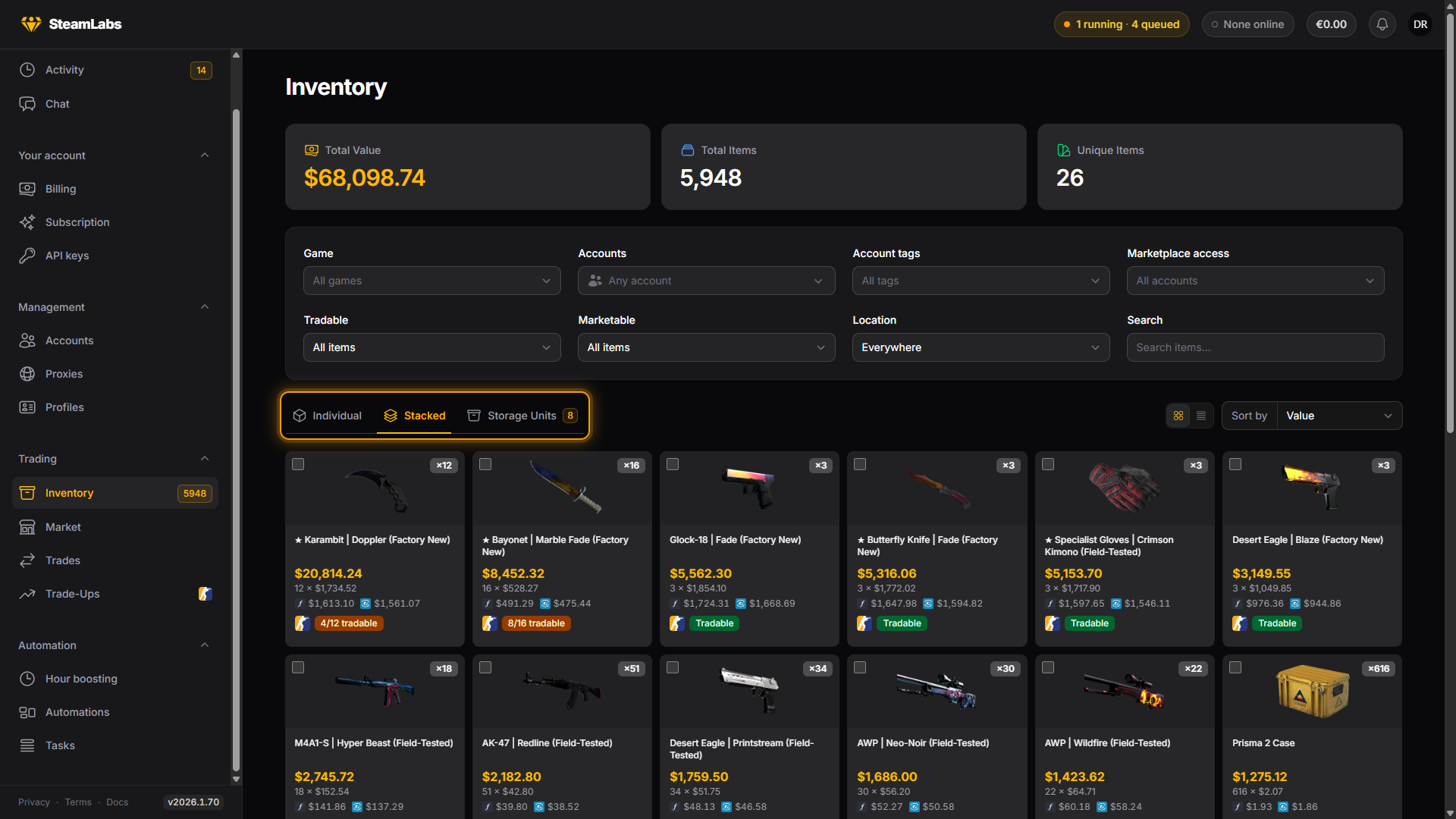
The three views
Switch views with the buttons above the grid.

| View | One entry is |
|---|---|
| Stacked | One item, counted across every account |
| Individual | One Steam asset, on one account |
| Storage Units | One CS2 storage unit, not the items inside it |
Stacked is the one to use for "how many of these do I have". Individual is the one to use when a specific copy matters, since only it can show float and stickers. Storage units never appear as items in the first two views: a unit is a container, and Storage units covers it on its own.
Each view has a Gallery view and a List view, and its own sorts. Stacked and Individual sort by value, name, quantity and recently acquired, Individual adds float (lowest first), and Storage Units sorts by fill level or name.

Filtering
The filter row narrows every view at once:
- Game: CS2, TF2, or plain Steam items
- Accounts and Account tags: whose items to show
- Marketplace access: only items on accounts that could sell on Steam, CSFloat or Market.CSGO right now
- Tradable and Marketable: including Sellable now, which means marketable and on an account that could really list it
- Location: Main inventory, In storage units, or everywhere
- Search: matches the item name word by word, in any order
The stat cards above the grid (Total Items, Unique Items, Total Value, In Storage, Capacity) follow your filters, so they double as a quick answer to "what is this slice worth".
Selecting items
Click a card to select it. In Stacked view you pick a quantity from the stack instead, and SteamLabs decides which accounts' copies to use.
Select page takes everything on the current page. Select all takes everything matching your current filters, up to a cap:
| View | Cap |
|---|---|
| Stacked | 500 stacks |
| Individual | 1,000 assets |
Past the cap the selection is trimmed and you get a notice. Narrow your filters and repeat, or use the fleet-sized versions on Tasks → Create tasks, which work from rules rather than a list of items.
Some items are never picked up by a selection action, even when they are selected:
- Items inside a storage unit, for anything except withdrawing
- Items already listed on a marketplace, or staged as a trade-up input
- Items the action itself cannot use, for example untradable items when sending
What you can do with a selection
The bar at the bottom of the page holds five actions.
| Action | What it does | More |
|---|---|---|
| Send items | Creates trade offers to your own accounts, a trade URL, or by rules | Trading |
| Store | Deposits CS2 items into storage units | Storage units |
| Trade up | Crafts eligible CS2 items into ten-item contracts | |
| Sell items | Lists on Steam, CSFloat or Market.CSGO | Market |
| Use | Consumes armory passes and TF2 backpack expanders |
Every one of them queues worker tasks rather than acting on the spot. Follow them on Tasks.
A greyed button means your plan does not include that action. Hover it to see which plan unlocks it.
Item details
Click View details on any card for the full picture: which account holds it, when it was first seen, its asset ID, and for CS2 items the origin, float and wear, pattern seed, paint index, StatTrak count, name tag, stickers and charms.
The same slide-over shows current market prices from every source we track, with how long ago each was updated.
Using items
Use applies items in place, on the account holding them. Two things qualify: CS2 armory passes, which get activated, and TF2 backpack expanders and similar usable store items, which get applied.
Anything else in the selection is ignored, and items inside a storage unit are skipped since nothing can be used from inside a container.